Sustainable Product Development
We have taken great steps towards improving the sustainability of our product ranges:
The circular economy and the reduction of embodied carbon are key factors in the specification and development of new products and will help shift the industry to more sustainable business practices.
All components are mounted using standard fasteners allowing simple replacement with commonly available tools fasteners allowing simple replacement with commonly available tools.
Only components from European brands such as Philips, Osram and Tridonic are used, ensuring replacement parts are widely available and that they offer state of the art life expectancy.
We use lithium batteries with substantially longer life expectancy than traditional chemistries such as Nickel Cadmium or Nickel Metal Hydride.
We use premium LEDs offering exception life expectancy up to L90 at 80,000 operating hours ensuring both longevity as well as best in class efficiency reducing power consumption and therefore minimising CO2 emissions.
We recognise the importance of embodied carbon in achieving sustainability goals. In order to ensure transparency with regards to the environmental impact of both our products and our factory we have invested heavily in supporting data and are able to offer TM65 embodied carbon calculations for every product we manufacture covering nearly 20,000 product SKUs, as well as TM66 CEAM assessments for all of our product ranges.
Continuous improvements & Circular Economy
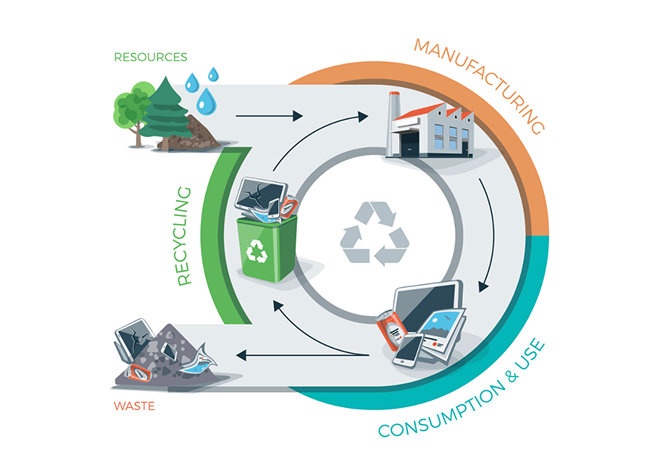
Every item bought or sold comes from raw materials extracted from the Earth; manufacturers turn these materials into products, and eventually, they are discarded as waste. This linear process drains the planet’s finite resources while generating significant waste and emissions.
An alternative model is to become less linear and more circular. This means considering a product’s lifetime and maintainability as well as the possibility to reuse, refurbish or even remanufacture once the product’s initial use comes to an end. This circular approach captures and keeps materials in use at their highest value. This idea has been evolving since the 1980s; it aims to minimise waste and pollution by optimising the value and use of resources.
The linear approach of creation, consumption, and disposal is not sustainable. Circularity is a strategy to increase sustainability, reduce waste and maximise the reuse of materials.
Packaging at Dextra Group
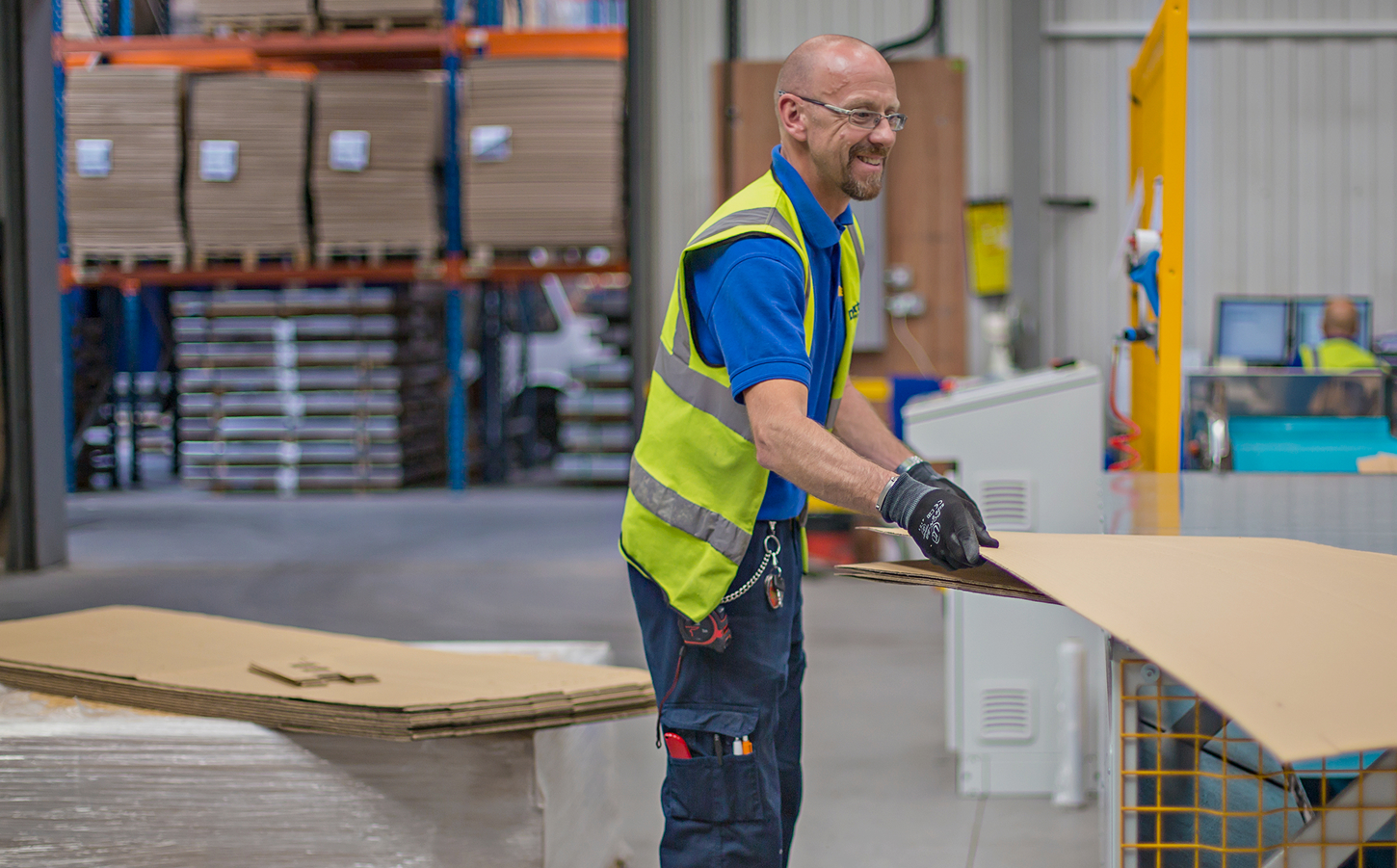
Dextra Group have removed all single use plastics and polystyrene from all of our packaging. Luminaire packaging is now in wooden crates with minimal cardboard usage, simplifying waste disposal on site with a single material type that can be fully recycled.
‘Box on Demand’ equipment linked to our bespoke works order system enables us to tailor packaging to the individual product or a customer’s requirement. A new equipment upgrade that utilises slot and tab features will negate the need for tape usage, enable boxes to be reused and assist our commitment to reduce the environmental impact of our business operations.